








Ideal Cut vs. Excellent Cut Diamonds: What’s the Difference?
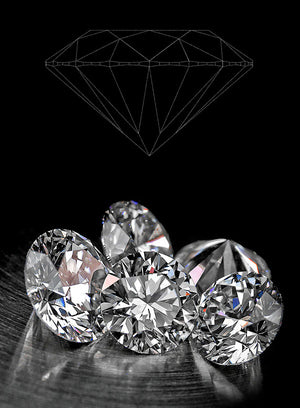
‘Ideal’ and ‘Excellent’ cut diamonds are the two finest gradings given to diamond cuts by the American Gem Society (AGS), with each grade determined by various factors concerning how they interact with light.
‘Ideal’ is considered the highest grade due to its highest possible precision, proportions, maximum brilliance, and exceptional symmetry. ‘Excellent’ cuts are the next rank down, with near-perfect symmetry, but they may have slight variations in proportions, resulting in slightly less reflection. However, this is almost impossible to spot with the naked eye.
Confusion can arise, however, due to the use of ‘Excellent’ across different lab grading systems. In this guide to Ideal vs. Excellent Cut Diamonds, we’ll clarify the differences, so you can make an informed decision on your purchase.
Ideal Cut Diamond Proportions Chart
|
Proportion Focus: |
Measurement |
|
Table |
53-58%the of diameter |
|
Depth |
59 to 62.6% |
|
Crown |
Proportionate to pavilion depth |
|
Symmetry |
Precise facet alignment |
Ideal vs. Excellent Cut Diamonds Chart
|
Feature |
Ideal Cut (AGS or Super Ideal) |
Excellent Cut (GIA) |
|
Brilliance |
Maximum light return |
Very high, but can vary |
|
Light Performance |
Graded via ASET (AGS) |
Not evaluated |
|
Facet Precision |
Extremely tight tolerances |
Broader allowance |
|
Hearts & Arrows |
Often present (Super Ideal) |
Rare |
|
Price |
Premium for top precision |
Often more value-friendly |
|
Certification Labs |
AGS, BGD (Super Ideal) |
GIA |
What is a Diamond Cut and Why Does it Matter?
Put simply, a diamond cut grade is an assessment of how well the diamond interacts with light - from Ideal to Poor. Ideal cut diamonds reflect light immaculately, whereas poorly rated diamonds will ‘leak’ light and reduce their sparkle.
To most people, a diamond’s cut is the most important factor in its quality. It affects brilliance, fire, and scintillation - the core qualities that make a diamond sparkle. This is important to know because with an ideal quality cut, you can enjoy a stunning sparkle, even if other qualities are lacking, potentially lowering your purchase cost.
How is a Diamond Cut Determined?
A diamond’s cut is determined by a grading scale, developed by trusted institutions such as the GIA (Gemological Institute of America) or American Gem Society (AGS).
However, confusion can arise as ‘Excellent’ is used differently by each lab:
-
The GIA (Gemological Institute of America) ranks ‘Excellent’ as the highest cut.
-
The American Gem Society (AGS) ranked ‘Ideal’ as the highest cut (and ‘Excellent’ as the second highest).
-
Most internet retailers and experts refer to the AGS ranking, which is why you see the use of ‘Ideal’.
The grading standards of the two gemological laboratories are comparable for the following characteristics:
-
Carat Weight.
-
Clarity.
-
Color and Fluorescence.
Both gemological laboratories use Sarine computerized proportions technology to measure diamonds and calculate the proportions. In order to do this, the Sarine unit measures eight facets per section. Then, it adds those numbers together and divides the sum by eight to determine the average. That part of the process is straightforward and makes perfect sense.
However, the criteria for diamond cut quality between AGS and GIA are dramatically different. Despite both using Sarine technology, only the American Gem Society Laboratory (AGSL) grades diamonds for light performance, and the Angular Spectrum Evaluation Tool (ASET) is proprietary to the AGS Laboratory.
So, the perception of diamond proportions may vary depending on the perspective of each laboratory.
AGS’ Diamond Cut Grading
AGS’ cut grading system is based on ‘Light Performance’, which grades diamonds on eleven factors that affect light performance. It is considered more detailed than GIA cut grades, which only consider polish, symmetry, and proportions.
AGS’ Performance-Based Cut Grading System uses modern hardware and software to create a virtual 3D model. This is then imported into AGS’ ray-tracing software, which provides values for proportions and light performance. The diamond grader will analyse the girdle, the culet, the symmetry, and the polish characteristics of the diamond.
AGS determines the final cut grade based on:
Light Performance Grading
-
Brightness: The amount of white light returned, including in imperfect lighting environments.
-
Dispersion: Also known as ‘fire’, this is all about how the white light separates into spectral colors. A finely cut diamond will display a large number of spectral colors (like a rainbow). This gives it that magical sparkle.
-
Leakage: Areas that fail to return light.
-
Contrast: How light and dark patterns are seen on the diamond, which can produce an optical effect. The more positive contrast it has, the more interesting a diamond is considered to look.
Proportion Factors:
-
Girdle Thickness: Ideal cut diamonds have a perfect balance of girdle, which is measured as a percentage.
-
Culet Size: The size of a culet facet (aka the point of the diamond).
-
Weight ratio: The weight of the diamond to its millimeter footprint. Ideal cut diamonds have a perfect balance.
-
Durability: The resistance to chipping.
-
Tilt: The angle at which the girdle reflects under the diamond’s table. Ideal diamonds will not exhibit a ‘fish-eye effect’, where the girdle edge is reflected to the viewer when viewed from a normal angle.
Finishing Factors:
-
Polish: How well it has been polished, to remove surface imperfections.
-
Symmetry: How much symmetry the diamond has from its cut - the higher the better.
What Is an Ideal Cut Diamond?
AGS’ Ideal Cut
On AGS’s cut grading, AGS-0 Ideal is the very finest grade of diamond cut. It is what the rest of the industry, such as the GIA, refers to as ‘Excellent’.
To receive an AGS ideal rating, all diamond cut quality factors are graded at the highest possible levels. Cut quality of this level is therefore considered rare, but as other factors contribute to a diamond’s overall grading, ideal cuts aren’t just found in flawless diamonds, but in various other lower quality diamonds too.
The Importance of The Angular Spectrum Evaluation Tool (ASET)
The AGS lab developed ‘Angular Spectrum Evaluation Technology’ (ASET) to grade the Light Performance. This ASET image is provided in the diamond details page for a GIA Excellent cut round diamond that has a total depth of 61.8% and a table diameter of 57% with a pavilion angle of 40.8 degrees, which is offset by a crown angle of 34.5 degrees. The proportions of the diamond are in the middle of the spectrum designated for the AGS zero ideal cut rating, and the overall cut grade of the diamond is GIA Excellent. But this ASET image shows extensive light leakage under the table facet, as indicated by the green arrows.
From our perspective, this diamond is a perfect example of one of the primary differences between standard ideal and super ideal cut diamonds. The proportions of this diamond are spot-on, right in the middle of the spectrum, but the optical precision of the diamond does not meet our standards for the super ideal cut classification.
Compare the ASET image above with the ASET image for this 1.316 carat, E-color, VS-1 clarity, Brian Gavin Signature round diamond. Notice how consistent the distribution of red, green, and blue is throughout this super ideal cut diamond. There are no signs of light leakage under the table facet; there is a lot of red, which indicates the highest level of brightness. Both diamonds were photographed on a white background. Both diamonds are the same relative carat weight, and both diamonds have proportions in the middle of the spectrum for the zero ideal cut proportions rating. The difference between the diamonds is the degree of optical precision.
ASET can be of great help to truly break down the differences in a diamond in the same cut grade, and can help you avoid purchasing a diamond that isn’t as sparkling as you dreamt.
The Ideal Cut’s Origins
The ideal diamond cut can be credited to Marcel Tolkowsky. In 1919, the Belgian diamantaire and mathematician developed a form that the modern round brilliant ideal cut diamond is still based upon.
Tolkowsky’s diamond design was based on modern theories of light behavior. He called for a total depth of 59.3% with a table diameter of 53% and a crown angle of 34.5 degrees (which is offset by a pavilion angle of 40.75 degrees). However, he was basing his calculations upon environments where the world was transitioning from candlelight to electric light and omitted the girdle edge measurement.
Today, we have adjusted his measurements to meet modern lighting standards and cutting systems. Using computerized mathematical ray tracing and proportions analysis, we can accurately determine the proportions of a diamond without having to visually estimate them, and model the behavior of light as it travels through a diamond of those proportions.
As the machines that measure diamonds and calculate their proportions round measurements off, so don’t bother scouring the globe for a diamond with a pavilion angle of 40.75 degrees because the machines will round that measurement up to 40.8 degrees, and would round it down to 40.7 degrees if the average measurement was 40.74 degrees.
Excellent Cut Diamonds Explained
AGS’s Excellent Cut
As the second-highest rating in AGS diamond cut grading, excellent diamonds tend to fail in light leakage quality, compared to ideal diamonds, as well as the volume and intensity of the sparkle factor. This is usually affected by the consistency degree of optical preciousness, the consistency of facet shape, size, and alignment of the facets from a 360-perspective. Any variance in these factors negatively affects the way light interacts with the diamond.
That’s because it can take around 4X longer to polish an ideal cut diamond to exhibit a higher degree of optical precision. So costs go up.
GIA’s Excellent Cut
The GIA spent 15 years fine-tuning its cut grading system, which is made up of a five-point scale ranging from Excellent to Poor. GIA’s ‘Excellent’ grading is its highest. The grading system determines:
-
How brightness, fire, and scintillation appear when viewed face up.
-
The diamond’s durability and weight
-
The quality of workmanship and craftsmanship.
As you can see, these criteria are very different from the detailed criteria used by AGS (as explained above). So, you may find that the quality of a GIA excellent cut is very differ from that of an AGS ideal cut.
What are Super Ideal Cut Diamonds?
‘Super ideal cut’ is not an official lab grade cut. You won’t find this on the AGS or GIA cut grade charts.
But, within the diamond community, this is an unofficial way of separating even the finest differences of ideal-cut diamonds. After all, the gemological labs don’t take optical precision into account as part of the grading process. It’s been estimated that fewer than 0.001% of round diamonds are cut to the higher degree of optical precision necessary to produce a crisp and complete pattern of hearts and arrows.
It’s generally considered that a ‘super ideal cut diamond’ is a round brilliant cut diamond which has:
-
Been cut to a level of perfection that will warrant an overall cut grade of either GIA Excellent or AGS Ideal-0.
-
Been cut to the center spectrum of the range designated by the AGS Laboratory for the zero ideal cut proportions rating (this is essentially the range designated by Marcel Tolkowsky as an ideal cut diamond).
-
Exhibits a crisp and complete pattern of Hearts & Arrows.
Brian Gavin’s Signature Diamonds are examples of textbook super ideal cut diamonds, with an AGS Ideal-0 grading.
Which Diamond Cut Should You Choose: Ideal vs. Excellent Cut Diamonds?
Diamond cut quality always has the biggest impact on sparkle. So if that’s your priority, then ideal cuts are your best options. These diamonds have been crafted with exacting proportions to reflect light beautifully under all lighting conditions.
However, if you’re on a smaller budget, then you may want to consider an Excellent cut. These are very hard to differentiate with the naked eye, especially for those who aren’t collectors or diamond experts. Although the sparkle will be slightly less intense, it will still be impressive.
Trusted by educated buyers. Chosen by perfectionists.
Still not sure which cut is right for you? Feel free to contact us today for expert guidance tailored to your needs - The cut they’ll notice. The sparkle they’ll remember.
FAQs: Ideal vs. Excellent Cut Diamonds
Is an Ideal cut better than Excellent?
Yes. Ideal cut diamonds are crafted with stricter proportions and symmetry, offering superior brilliance, fire, and overall light performance compared to standard Excellent cuts.
Can a GIA Excellent diamond sparkle less than an AGS Ideal?
Yes. AGS Ideal cuts are graded using advanced light performance metrics, while GIA Excellent focuses more on proportions. As a result, some GIA Excellent diamonds may sparkle less than AGS Ideal ones.
When is the Ideal cut more expensive?
Ideal cut diamonds require more precision in cutting, often sacrificing carat weight for optimal light return. This added craftsmanship typically results in a higher price point.
What is a Super Ideal cut diamond?
Super Ideal is a term used by diamond retailers and the community to describe diamonds that not only meet Ideal standards but also score top marks in light performance tools like ASET and Hearts & Arrows. It is not an official grading.
Can I see the difference with my eyes?
With side-by-side comparisons, Ideal cuts may generally show more fire and brilliance, though the difference may be subtle to the untrained eye.

Leave a comment