








Internally Flawless vs VVS 1 Clarity Diamonds
When it comes to the four Cs of diamond quality—Cut, Color, Carat, and Clarity—the latter is one of the most widely discussed characteristics. According to the AGS and GIA scales, two of the highest clarity grades are Internally Flawless (IF) and Very Very Slightly Included 1 (VVS1).
Both of these diamond grades promise exceptional quality, and their differences are subtle. The significance of a VVS1 vs IF diamond, therefore, varies, depending on the buyer’s priorities and sentiment. Here, we take a closer look at how these grades compare and ask whether one is truly “better” than the other.
The Difference Between Internally Flawless and VVS-1 Clarity:
Let’s begin with a better understanding of the differences between an Internally Flawless and VVS-1 clarity diamond. The grading criteria for determining whether a diamond is “internally flawless” is that there not be any inclusions visible under 10x magnification, which is the industry standard for diamond grading.
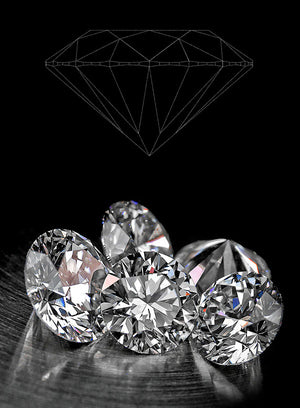
Minor blemishes may be present on the surface of the diamond. This is why you’ll see the comment “minor details of finish are not shown” (on the plotting diagram) on the lab report. So, this 1.02 carat, D-color, Internally Flawless, Brian Gavin Signature hearts and arrows diamond (pictured above) has no inclusions visible at 10x magnification.
However, minor inclusions might be visible if the diamond is viewed using a higher degree of magnification, such as 30x, 40x, 50x, or higher. For example, it might be possible to find a pinpoint size diamond crystal, or something like that, at a higher degree of magnification. But the inclusion is not visible at 10x, and thus, the diamond is graded as internally flawless.
Is Internally Flawless Clarity Worth It?
IF clarity carries a particular prestige factor with it. This grading suggests a flawless diamond with no internal inclusions, even under 10x magnification, which holds significant symbolism for many buyers and justifies the elevated price. These buyers typically include:
-
Luxury buyers seeking the absolute highest quality
-
Collectors of rare and exceptional diamonds
-
Private buyers who associate symbolic meaning with "perfection"
As far as most consumers are concerned, the additional cost of IF diamonds doesn’t come with noticeable visual benefits, as the clarity is not visually distinguishable between VVS1 vs IF. In some cases, it’s even hard to distinguish between these and even lower grades, such as VS1. The difference, therefore, lies in the diamond’s rarity, not its visible beauty.
As diamonds form under extreme pressure, a flawless internal formation is highly uncommon. It is this rarity that drives up the price of IF diamonds, not their appearance. Rarity translates into symbolic, collectible, or emotional value, but if you prioritize aesthetics over a diamond’s rarity, a VVS1 diamond offers better value for money for the same visual result.
Can You See the Difference Between VVS1 and IF Diamonds?
Both VVS1 and IF diamonds are described as “eye clean,” meaning that there is no visible difference between them, and you won’t see any imperfections without magnification. Notably, IF diamonds have the distinction of containing no inclusions, even under strong magnification.
VVS1 diamonds, on the other hand, contain minuscule inclusions that are almost impossible to detect, even by trained gemologists, using 10x magnification. These inclusions are typically positioned near the edges or outside the table (a cut diamond’s flat, top surface), making them invisible to the naked eye.
|
Feature |
VVS1 |
IF |
|
Clarity Grade |
Very Very Slightly Included 1 |
Internally Flawless |
|
Eye Clean |
Yes |
Yes |
|
Visible Inclusions |
None to the naked eye |
None, even under 10x magnification |
|
Rarity |
Very rare |
Extremely rare |
|
Price (vs VVS1) |
Slightly lower |
Highest |
|
Value Perception |
Excellent |
Represents perfection |
So, yes, a trained gemologist with strong magnification tools will be able to detect minor inclusions in a VVS1 vs IF diamond. It is up to the buyer to determine whether an internally flawless clarity is worth paying the extra premium for.
Are Internally Flawless Diamonds Better Than VVS1?
By definition, an IF diamond is better than its VVS1 counterpart, because there are no internal inclusions, compared to the tiny ones signified by the words “Very Very Slightly Included.” With that said, whether this makes IF diamonds “better” is open to discussion, as this ultimately depends upon your budget and goals.
-
If your goal is to achieve perfect symbolism or buy a collector’s piece, IF is better.
-
If you wish to get the best value for a visually stunning diamond, VVS1 is better.
-
If you want to maximize beauty versus budget, then consider paying more attention to the cut than to clarity.
Regarding this last point, according to Brian Gavin Diamonds, the diamond’s cut quality often makes a more noticeable difference than barely perceptible changes in clarity grade. An exceptionally well-cut VVS1 diamond will—quite literally—outshine its poorly-cut IF counterpart, and represent better value at the same time.
Are IF Diamonds Always Eye Clean?
The answer is yes, by definition, Internally Flawless diamonds are always eye clean, as they contain no visible internal inclusions, even under 10x magnification. At this level, any surface blemishes that might have remained are polished away, leaving a flawless and stunning piece.
However, it’s worth noting that VVS1 diamonds are also eye clean, and this is where value for money comes into play. Is it really worth paying more for something that’s not visible to the naked eye? Both of these grading standards place these diamonds among the highest quality, according to the American Gem Society Laboratories (AGSL), and should be considered premium examples in a highly aspirational market.
So, which is better, a VVS1 vs IF diamond? In either instance, you will be purchasing a diamond with exceptional clarity that surpasses what most buyers would even consider. However, it’s worth remembering that clarity is only one characteristic. Cut is often king, and insisting on a superior cut from a reputable name like Brian Gavin Diamonds will elevate your diamond’s appeal far more than merely jumping from one clarity grade to another.
How Much Does a VVS-1 Clarity Diamond Cost (compared to IF clarity)?
When comparing the price of Internally Flawless (IF) and Very Very Slightly Included 1 (VVS1) diamonds, it’s important to understand that clarity is just one of many factors influencing cost; color, cut, and rarity also play major roles.
To illustrate this, consider three round brilliant diamonds from our Virtual Selection:

1.080 carat, E color, VVS1 clarity: $5,729.22 ($5,671.93 with wire discount)

1.080 carat, D color, VVS1 clarity: $9,623.58 ($9,527.34 with wire discount)

1.04 carat, E color, IF clarity: $10,725.13 ($10,617.88 with wire discount)
At a glance, all three diamonds are eye clean and exhibit excellent cut, polish, and symmetry. Yet the price difference between the E/VVS1 and E/IF diamonds exceeds 85%, despite just a single clarity grade separating them. Why?
The answer lies in rarity. Internally Flawless diamonds are exceptionally uncommon. Fewer than 1% of all gem-quality diamonds meet this standard. That rarity drives a premium, especially among collectors or buyers seeking a symbolically “perfect” stone.
Similarly, upgrading from E to D color within the same clarity (as seen in the two VVS1 diamonds) carries a substantial increase in price due to the near-absence of color in D-grade stones.
For most buyers, a well-cut VVS1 diamond offers the same visual performance as an IF, especially under normal viewing conditions. Unless symbolic perfection is your goal, a VVS1 diamond typically delivers stronger value for money without sacrificing brilliance or beauty.

Leave a comment