







Three Stone Engagement Rings
Symbolize your past, present, and future within three stones in our dazzling three-stone engagement rings. Three Stone Rings, also known as trilogy rings, feature a stunning center diamond (natural or lab-grown), cut in-house to our exemplary standards, flanked by two smaller, accentine stones. Find your perfect ring below. Read more
-
 Original price €2.367,95 - Original price €2.793,95Original price€2.367,95 - €2.793,95€2.367,95 - €2.793,95Current price €2.367,95
Stella
Three stone bezel set engagement ring with 2 diamond melee ( approx. 0.20 ctw) and half bezel center. Ring can be made for any shape and/or size ce...
View full detailsOriginal price €2.367,95 - Original price €2.793,95Original price€2.367,95 - €2.793,95€2.367,95 - €2.793,95Current price €2.367,95 -
 Original price €3.459,95 - Original price €3.792,95Original price€3.459,95 - €3.792,95€3.459,95 - €3.792,95Current price €3.459,95
Gwen
3-stone ring holds 1 carat round center diamond set in 4-prongs and two 1/2 bezel set side stones weighing 0.48 carats total.. Ring can be made for...
View full detailsOriginal price €3.459,95 - Original price €3.792,95Original price€3.459,95 - €3.792,95€3.459,95 - €3.792,95Current price €3.459,95 -
 Original price €1.664,95 - Original price €2.016,95Original price€1.664,95 - €2.016,95€1.664,95 - €2.016,95Current price €1.664,95
Hemera Bridal R5381
This Parade™ Signature Hemera Bridal is made for around diamond center. It is accented by round G/H SI1+ diamonds. Carat Total Weight: 02-RD 0.15 C...
View full detailsOriginal price €1.664,95 - Original price €2.016,95Original price€1.664,95 - €2.016,95€1.664,95 - €2.016,95Current price €1.664,95 -
 Original price €11.089,95 - Original price €11.117,95Original price€11.089,95 - €11.117,95€11.089,95 - €11.117,95Current price €11.089,95
Graciosa
Graciosa (Latin for graceful). This is not your average Three Stone Ring. Handmade prongs and stone seats are forged from platinum wire and are met...
View full detailsOriginal price €11.089,95 - Original price €11.117,95Original price€11.089,95 - €11.117,95€11.089,95 - €11.117,95Current price €11.089,95 -
 Original price €2.242,95 - Original price €2.455,95Original price€2.242,95 - €2.455,95€2.242,95 - €2.455,95Current price €2.242,95
Annalise 3 Stone Marquises
Three Stone setting featuring approximately 2 x 0.09 carat F/G VS Marquise Diamonds. The marquise diamonds have V-tip prongs on both sides. Add $1...
View full detailsOriginal price €2.242,95 - Original price €2.455,95Original price€2.242,95 - €2.455,95€2.242,95 - €2.455,95Current price €2.242,95 -
 Original price €2.608,95 - Original price €2.950,95Original price€2.608,95 - €2.950,95€2.608,95 - €2.950,95Current price €2.608,95
Emma
French set halo engagement ring with 16 (0.16 ctw) diamond melee and 2 (0.16 ctw) accent side diamonds. Ring can be made for any shape and/or size ...
View full detailsOriginal price €2.608,95 - Original price €2.950,95Original price€2.608,95 - €2.950,95€2.608,95 - €2.950,95Current price €2.608,95


The Symbolism & Beauty of Three Stone Rings
The GIA describes a three-stone engagement ring (also known as a trilogy or trinity ring) as a setting with one center diamond, flanked by two small side stones.
It’s a classic design for a diamond engagement ring, wedding ring, or anniversary ring, and a visually powerful expression of the past, present, and future of a relationship. Additional stones increase sparkle and width, making the ring feel more impressive overall without distracting from the center diamond, which can mean so much.
The three-stone engagement ring setting dates back to at least the 17th century and was a beloved choice during the Victorian era.

What does a three-stone engagement ring mean?
The ever-popular three-stone diamond ring setting reflects your relationship over time. The three-stone ring symbolizes different stages of your journey together.
The larger middle stone signifies the present and where you are as a couple. In contrast, the matched side stones represent how the past and future support and sustain your commitment to a lifelong partnership together.
Other interpretations see the three-stone engagement ring as representing synthesis, harmony, and unity, as well as the marriage of mind, body, and spirit, and past, present, and future.
For that reason, they’re widely chosen as commitment gifts, whether for an engagement or as an anniversary gift.
How do you choose the center and side stones in a trilogy diamond ring setting?
As a general rule, side stones are usually one-half to one-third the size of the center stone (by outside diameter).
To build your ideal three-stone engagement ring, we recommend starting with your dream center stone. Then select side stones that complement the size, shape, color, and clarity.
Learn more about the 4Cs of diamonds here.
Matching shapes or mixing them
Whether you mix or match depends on whether you want a classic, symmetrical look or a more distinctive, personalized design.
The traditional side stone choices are three diamonds of the same shape, often with a larger middle stone.
However, you can be creative and select both the middle stone and side stones in varying shapes or different types of gemstones.
A contrast in shape can help your center stone stand out. For example, a fancy cushion-cut center diamond between two half-moon-cut diamonds could create a very characterful touch.
Matching color and sparkle across all three stones
Like shape, your choice of color and sparkle can also have a big impact on your 3-stone diamond ring setting.
For a cohesive look, we recommend side stones within two color grades of the center diamond. However, if you’re opting for a fancy color diamond, you may want to create contrast by opting for whiter side stones.
For scintillation, we recommend side stones with a cut quality similar to the center diamond for consistent sparkle. However, for fancy shapes, you’ll need to consider proportions and symmetry, since cut grade isn't assigned to fancy shapes.
Which three stone-setting styles are right for you?
Your choice of a three-stone engagement ring setting can affect how light passes into the diamonds and how well the center stone is protected.
As always, the choice is yours, but here are some tips:
Prong and basket settings
- Three Stone Engagement Rings emphasize their symbolic significance by using a prong mount with the center stone slightly raised or prominent. This approach maximizes the sparkle and gives that classic, dreamed of, "diamond ring look."
- Basket settings also use prongs, but add horizontal supports to create a basket-like framework. They’re ideal for the openness of prongs, but with extra support beneath each stone.
Trellis settings
- Trellis settings use interwoven, crossing prongs that rise and hold the diamond in a lattice-like framework. The open spaces between the prongs allow light to pass through, enhancing the ring’s overall sparkle.
- This stunning and open design adds depth and security with a unique side profile.
Bezel and half-bezel settings
- Bezel settings frame each diamond in a smooth, protective ring. This provides exceptional durability for those with a hands-on lifestyle and adds a gorgeous metallic look.
- Half-bezels leave some ovals open, but protect the diamond’s vulnerable corners, making them a popular choice for fancy-shaped stones that need protection.
Halo Three Stone Rings
- Halo ring settings for three-stone ring settings surround the center stone, or all three diamonds, with a border of smaller stones. This creates a beautiful sparkle around the center stone, while retaining the face-up silhouette.
Hidden Halo Settings
-
Hidden halo settings do the same, but keep the center diamond the clear focus by concealing the diamonds so that they’re only visible from the sides.
Semi-mount settings
- Semi-mount settings are crafted settings sold without the center stone, but with side stones included. This gives you the option to choose the center diamond to complete your ring.
Three Stone-Settings At A Glance
|
Setting style |
How it holds the stones |
Look and wear |
|---|---|---|
|
Prong |
Metal prongs bend over each stone's edge |
Most light into the diamonds, for a classic look |
|
Basket |
Prongs joined by horizontal supports under each stone |
Secure and open, with the stone sitting a little higher |
|
Trellis |
Prongs cross over one another along the stone's sides |
Woven side profile, giving a strong hold |
|
Bezel / half bezel |
A thin metal rim wraps all or part of the edge |
Low, snag-resistant, modern |
|
Open gallery with accents |
Prong head with small accent diamonds on the gallery |
Extra sparkle from the side |
|
Semi-mount |
Side stones set, with center left open |
Intricate and durable |
Which metal is best for a three-stone ring?
There’s no ‘best’ metal; it’s all about your priorities. For example, when choosing between 18k white gold and platinum, platinum is usually the better choice for durability and skin sensitivity, but gold is better for a rich white-metal look.
Can you use lab-grown diamonds in a three-stone ring?
To the naked eye, lab-grown diamonds appear the same as natural diamonds. Only under microscopic study are the true differences visible. For that reason, yes, you absolutely can use lab-grown diamonds as either the center stone or side stones in a trilogy diamond ring setting.
However, many people still prefer the sentimental value of a natural diamond, since they are a miracle of nature that forms deep underground over millions of years. This gives them huge demand and long-term value that lab-grown diamond engagement rings don’t offer.
Brian Gavin Diamonds’ lab-grown collection features lab-grown diamonds with GIA and AGS certification, treated to the same high standards of cutting, proportions, and craftsmanship.

How much does a three-stone engagement ring cost?
3-stone diamond ring settings range from around $1,375 to over $10,000 for the setting only. The final ring price will vary depending on the center diamond and two side stones you choose, as well as the setting’s metal, design, and any other included accent diamonds.
For context, according to The Knot (U.S. wedding-planning platform), the average engagement ring spend is around $4,600.
Learn more in our three-stone ring buyer’s guide.
How does Brian Gavin build your three-stone ring?
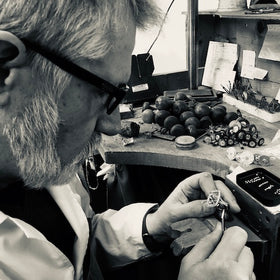
Brian Gavin Diamonds builds three-stone diamond rings entirely in-house. As a fifth-generation cutter, we have extremely high standards, meaning each ring and stone benefits from our exemplary precision cutting standards and setting craftsmanship. Our Signature Collection also features our famous hearts and arrows and diamond cutting standards.
Our expertise also lets us build your custom ring in our Workbench. Here’s how you can get started:
-
Pick a setting
-
Pick a center diamond.
-
Pick matched side stones.
-
Inform us of any other custom details you’re after and let us build it.
FAQs on Three Stone Engagement Rings
1. What is a trilogy ring?
A trilogy ring is another name for a three-stone engagement ring, or trinity ring—it features one center stone, set between two smaller side stones.
2. What does a three-stone engagement ring symbolize?
A 3-stone diamond ring setting is said to symbolize a couple's past, present, and future, with the center stone representing the present. Some couples read the three stones as friendship, love, and fidelity instead. For this reason, they’re popular as commitment gifts for an engagement or anniversary.
3. What size should the side stones be?
Side stones are usually one-half to one-third the size of the center stone, compared by average outside diameter. Larger side stones give a bolder, wider look; smaller ones make the center look bigger. Our center stone-to-side stone ratio guide shows you how to calculate it for your center diamond.
4. Can I buy a three stone setting without the center stone?
Yes. Most three-stone settings at Brian Gavin are priced as the setting alone so that you can search loose diamonds separately. Some settings also leave out the side stones so that you can pick a matched pair of diamonds. However, we also have many pre-built rings with the diamond and side stones included in the price.
5. Can a three-stone ring use lab-grown diamonds?
Yes. Any of our three-stone settings can hold lab-grown diamonds, natural diamonds, or a mix. Brian Gavin Lab diamonds are cut to the same performance standard as our natural stones, and every listing states clearly which type you're buying.
6. How much does a three-stone engagement ring cost?
A three-stone engagement ring’s price depends mostly on the three diamonds; the setting is a smaller share. At Brian Gavin, settings start at about $1,375 (setting only). Your total depends on the center diamond's carat and quality, as well as the side stones.
