








What is the XXX Diamond Grade? (2026 Refresh)
"I'm shopping for a diamond for an engagement ring. You're shocked to discover that, I'm sure. But this is kind of a big deal for me, buying an engagement ring represents one of the biggest expenditures of my young life. I don't own a house yet, and am driving a hand-me-down car, and now I'm supposed to plunk down three months' salary on a diamond. Well the jokes on you De Beers, because I'm still in college. Perhaps that 2-3 month salary rule should be adjusted to include my student loans? In the meantime, can you explain what is the XXX diamond grade? My older brother just bought a XXX diamond for his engagement ring and told me to settle for nothing less. As usual, he couldn't tell me why. He just said that he's done all this research, and that's what I should buy also. Typical."
(Updated: August 14, 2026. Previously Updated: July 27, 2021. Original Publish Date: Dec. 26, 2016)
The GIA XXX cut grade:
"GIA-XXX" is a common abbreviation used to refer to diamonds graded by the GIA Gem Trade Laboratory with an overall cut grade of GIA Excellent. The GIA-GTL or just plain old "GIA" as it is commonly referred to, bases the overall cut grade of a diamond on three factors:
- Polish
- Symmetry
- Proportions
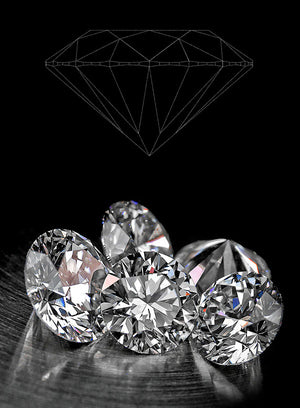
When a diamond receives the individual grade of excellent for all three factors of cut grade, it receives the overall cut grade of GIA Excellent. Thus, a GIA graded diamond that receives grades of excellent for polish, symmetry, and proportions is deemed to be GIA Excellent. Diamonds with an overall cut grade of GIA Excellent are commonly referred to as "GIA Excellent cut diamonds" and further abbreviated as GIA 3X, Triple X, or XXX as you've pointed out. Click here to search for over 15,000 GIA XXX Diamonds
Is GIA Excellent the best-cut diamond?
I have an older brother also, and in the spirit of sibling rivalry, I want to share with you the reasons why I have always preferred the light performance grading standards pioneered by the American Gem Society Laboratory over the standard GIA-GTL report. However, with the understanding that I find the grading standards of both laboratories to be comparable for the basics, such as:
However, I feel that the standard GIA report falls short when it comes to judging the light performance of a diamond. This is because the GIA cut grade does not take the actual light performance of diamonds into account as part of the grading process, but the AGS light performance system does. This is why Brian Gavin chose to send diamonds to the AGSL for grading for more than two decades, and why every eligible Brian Gavin diamond today is paired with the AGS Ideal Report by GIA. If that last sentence made you do a double take, keep reading, because the story of how the AGS light performance system ended up at the GIA is a plot twist worthy of a family drama.
How the AGSL measures Light Performance:
The American Gem Society Laboratory pioneered a proprietary technology known as ASET to determine the light performance of diamonds. ASET is an abbreviation for Angular Spectrum Evaluation Technology. The red, green, and blue colored image of a diamond that appears in the face-up position on the diamond grading report to the left, is the ASET image for this 1.330 carat, G-color, VS-2 clarity, Black by Brian Gavin round hearts and arrows diamond. This diamond has an overall cut grade of AGS Ideal-0, which means that it received an Ideal-0 rating for Polish, Symmetry, Proportions, and Light Performance. The highest rating available from the AGSL. I have no doubt that this diamond would receive an overall cut grade of GIA Excellent if we submitted it to the GIA Gem Trade Laboratory for grading. However, only the AGS light performance system can provide you with the additional insight offered by ASET, and these days you will find that insight on the AGS Ideal Report by GIA. More on that in just a moment.
GIA Excellent vs AGS Ideal-0 (sibling rivalry)
You might not be aware of this, but the GIA and AGS are siblings of sorts. Both organizations were started by Robert M. Shipley, however, we all know that siblings often feel the need to do things their own way. On that note, you might want to ask your brother about the ASET scope image for his GIA Excellent cut diamond. Before you do, you'll want to read this tutorial that explains what the different colors of an ASET mean. I'd love to be a fly on the wall for this conversation. Of course, if your brother purchased his GIA Excellent cut "XXX diamond" from a reputable vendor like Brian Gavin, he might actually have an ASET Scope image available. We have the capability in-house to photograph diamonds through an ASET Scope, as well as a Hearts & Arrows viewer, and an Ideal Scope. Which is why we provide these reflector scope images on the diamond details pages of all Brian Gavin Signature diamonds. Click here to search for over 15,000 GIA XXX Diamonds or Discover the perfection of Brian Gavin's AGS 000 Super Ideal Hearts and Arrows Diamonds
The sibling rivalry is over (the GIA and AGS reunion):
Remember that sibling rivalry I was just telling you about? Well, grab some popcorn, because the family drama has a happy ending. At the end of 2022, AGS Laboratories closed its doors, and the GIA acquired the intellectual property and technology behind the AGS light performance grading system, including ASET. The former AGS Laboratories facility in Las Vegas now operates as a GIA research center, where the combined research teams continue to advance the science of diamond light performance. In other words, the siblings finally moved back in together under one roof, and Robert M. Shipley is somewhere smiling about it.
Now, before you panic and think that the insight of AGS light performance grading vanished along with the lab, take a deep breath. Beginning in 2023, the GIA began offering the AGS Ideal Report as a supplement to the standard GIA grading report. The AGS Ideal Report by GIA uses sophisticated ray-tracing software to evaluate how more than 30,000 individual rays of light interact with the facets of the diamond. It measures the three components of light performance that the AGSL built its reputation upon:
- Brightness, which is the effect of all the internal and external reflections of white light.
- Fire, which is the display of dispersion as white light separates into flashes of spectral colors.
- Contrast, which is the relative size and arrangement of the bright and dark areas within the diamond.
The report is issued digitally, with a printed version available, and it can include the familiar red, green, and blue ASET map that we have relied on for years. To be perfectly clear, this is the same AGS Ideal-0 light performance criteria that the AGSL used, adopted by the GIA without watering it down. A diamond either meets the AGS Ideal standard or it does not.
Here is the part that would have sounded like science fiction back when this article was originally published in 2016. The AGS Ideal Report by GIA is also available for select fancy shapes, such as oval, emerald, and cushion cut diamonds. That is a big deal, because the GIA has never issued an overall cut grade for fancy shape diamonds on the standard report. Consequently, light performance verification is no longer a round brilliant exclusive.
What does all of this mean for you? It means that you no longer have to choose a side in the sibling rivalry. A diamond can be GIA XXX and carry the AGS Ideal Report at the same time, which is exactly how Brian Gavin diamonds are graded today. Every eligible Brian Gavin diamond is submitted to the GIA for grading and paired with the AGS Ideal Report by GIA, so you get the confidence of the world's most recognized grading laboratory plus the light performance insight that only the AGS system provides. Your brother settled for half of that equation. Just saying. Click here to search for over 15,000 GIA XXX Diamonds or Discover the perfection of Brian Gavin's AGS 000 Super Ideal Hearts and Arrows Diamonds
Diamond Proportions and Optical Precision:

You might be aware that the proportions of a diamond dictate the volume of light return and the balance of brilliance and dispersion. As a matter of fact, we think that the range of proportions allocated for the GIA Excellent Cut rating is too broad. This means that a lot of GIA Excellent cut diamonds are cut to proportions that are well beyond our preferred range. With this in mind, while shopping for a diamond, we recommend that you look for options that have proportions right in the middle of the spectrum that is designated as "the sweet spot" or target zone for diamond cutters like Brian Gavin. Although this may be true, the reality is that a lot of round brilliant ideal cut diamonds with proportions within this center range still leak a substantial amount of light because the degree of optical precision is lacking. To be perfectly clear, the term optical precision refers to the consistency of facet shape, size, and alignment as the facets are polished onto the surface of the diamond from the perspective of 360-degrees. The hearts pattern pictured to the left reflects the higher degree of optical precision exhibited by Brian Gavin Signature diamonds.
Creation of Hearts Patterns in Round Diamonds:

As a matter of fact, it takes the combined efforts of five different facet sections to create the hearts pattern exhibited by Brian Gavin Signature diamonds. The image on the left shows the main pavilion facets outlined in orange in the 12 o'clock position. The light reflects off of that facet and travels across the diamond where it reflects off of the lower girdle facets in the relative six o'clock position. The steeper angle of the lower girdle facets causes the new forming heart to separate from the arrowheads that are visible in the middle of the diamond. In order for each of the hearts to be consistent in size and shape, a total of 5 different facets must work in perfect harmony. Specifically, light reflects off of 2 pavilion main facets, 2 lower girdle facets, and 1-star facet from the crown section to create each heart. The pattern of eight hearts is created as light reflects off of all the facets of the diamond within those sections all the way around the stone. If there is any difference in the shape, size, or alignment of the facets, then it will be apparent in the hearts pattern as an inconsistency.
Why Brian Gavin Says "It's all in the hearts":
The presence of a crisp and complete pattern of hearts in a round or cushion cut diamond indicates a higher degree of optical precision. While that is all well and good, you might be wondering why it's important for a cushion or round brilliant cut diamond to exhibit a hearts pattern. After all, it's not like you're going to be able to see the hearts pattern once the diamond is set in a ring, am I right? Well, the reason why it's important for a round or cushion cut diamond to exhibit a crisp and complete pattern of hearts is that it indicates a higher degree of optical precision. Now, before you think that I'm talking in circles, I'll explain why that is important. The higher degree of optical precision will increase the volume of light return (reduce light leakage) and produce a higher number of virtual facets within the diamond. That means that the facet structure will produce more reflections of light within the diamond and that spiraling kaleidoscope effect will produce outward sparkle that is more vivid and intense. Click here to search for over 15,000 GIA XXX Diamonds or Discover the perfection of Brian Gavin's AGS 000 Super Ideal Hearts and Arrows Diamonds
Can a lab grown diamond be a GIA XXX diamond?
I can practically hear your next question already, because it comes up in nearly every conversation we have with shoppers these days. What about lab grown diamonds? Here is the thing that a lot of people miss: the laws of physics do not care where a diamond was born. A lab grown diamond is still a diamond, and the same principles of proportions, optical precision, and light performance apply to it in exactly the same way. A poorly cut lab grown diamond leaks light just as badly as a poorly cut natural diamond, and believe me, there are plenty of poorly cut lab grown diamonds out there, because many cutters chase carat weight and spread instead of light performance.
Now, here is where things get interesting from a grading report perspective. As of October 2025, the GIA moved away from issuing traditional 4Cs grades for lab grown diamonds and adopted a simplified quality assessment that classifies them with descriptive terms such as Premium and Standard, while other laboratories continue to issue full cut grades for lab grown diamonds. That makes reflector scope images like the ASET, Hearts & Arrows viewer, and Ideal Scope even more valuable in the lab grown arena, because they let you verify the light performance with your own eyes rather than relying on a broad category. This is precisely why the Brian Gavin premium lab grown diamonds are cut to the same exacting hearts and arrows standards as our natural diamonds and are presented with the same reflector scope imagery. Your brother probably has not figured this part out yet, so feel free to enjoy the head start.
Your GIA XXX diamond buying checklist:
At this point, you know more about the XXX diamond grade than your older brother, which was obviously the goal all along. So let's put that knowledge to work. Whether you buy from us or not, here is what I recommend that you ask for before pulling the trigger on any GIA XXX diamond:
- A GIA grading report showing Excellent grades for polish, symmetry, and cut. That is the Triple X part, and it is your baseline, not your finish line.
- The AGS Ideal Report by GIA, which verifies the light performance of the diamond using the ray-traced criteria that the AGSL pioneered.
- An ASET Scope image, so that you can see how the diamond gathers light from the brightest angles and where it might be leaking light. Remember to review the tutorial on what the different colors of an ASET mean first.
- A Hearts & Arrows viewer image, so that you can judge the optical precision of the diamond by the crispness and consistency of the hearts pattern. It's all in the hearts, remember?
- An Ideal Scope image, which provides another perspective on light return and light leakage.
- Proportions that fall in the middle of the spectrum, in the sweet spot that diamond cutters like Brian Gavin target, rather than out at the edges of the GIA Excellent range.
If a vendor cannot provide these images, that is not necessarily proof that the diamond is a poor performer, but it does mean that you are buying blind. We provide all of this imagery on the diamond details pages of Brian Gavin Signature diamonds because we believe you deserve to see exactly what you are paying for.
Frequently asked questions about the GIA XXX diamond grade:
Is a GIA XXX diamond the best cut diamond available?
A GIA XXX diamond carries the highest cut grade that appears on the standard GIA grading report, so it is certainly a smart place to start. However, GIA Excellent is a broad category, and diamonds at the top of that range outperform diamonds at the bottom of it by a visible margin. The best cut diamonds are GIA XXX and verified for light performance by the AGS Ideal Report by GIA, with reflector scope images to prove it.
Do all GIA XXX diamonds sparkle the same?
Not even close. Two diamonds can both be graded GIA Excellent while exhibiting noticeably different degrees of brightness, fire, and sparkle, because the proportions range for the grade is broad and the standard report does not measure optical precision or light performance. That is why we recommend comparing ASET images rather than assuming that XXX means identical performance.
What is the difference between GIA XXX and AGS Ideal-0?
GIA XXX means Excellent grades for polish, symmetry, and proportions. AGS Ideal-0 required Ideal ratings for polish, symmetry, and proportions plus light performance, which the GIA cut grade does not measure. Since the GIA acquired the AGS light performance technology, the modern equivalent of that gold standard is a GIA XXX diamond accompanied by the AGS Ideal Report by GIA.
Is the AGS Ideal Report still available now that AGS Laboratories has closed?
Yes. The GIA acquired the AGS Laboratories' technology and intellectual property when the lab closed at the end of 2022, and the AGS Ideal Report by GIA has been available as a supplemental report since 2023. It uses the same light performance criteria that the AGSL developed, and it is even available for select fancy shapes.
Is a GIA XXX diamond worth the money?
In my opinion, you should consider GIA XXX to be the minimum acceptable cut quality for a round brilliant cut diamond, since cut quality has the greatest effect upon the beauty and sparkle factor of the diamond. Just remember that the XXX designation is where your search should begin, not where it should end. Verify the light performance and optical precision, and you will end up with a diamond that makes your brother question all of his research.
Click here to search for over 15,000 GIA XXX Diamonds or Discover the perfection of Brian Gavin's AGS 000 Super Ideal Hearts and Arrows Diamonds
