








How Big Is a 1, 2, or 3 carat Diamond Going to Look on My Finger?
(Updated: August 14, 2026. Original Publish Date: August 12, 2020)
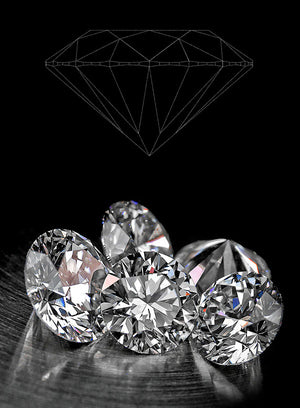
It’s no secret that the most popular size diamond is the one carat round. And yet, at the same time, the reality is that most people aren’t really sure how a 1-carat diamond is going to look on their finger. That’s probably because we’re more in-tune with what a one-carat diamond represents, as opposed to being familiar with the technical details. This 1.016 carat, F-color, VS-2 clarity, Black by Brian Gavin diamond has an average outside diameter of 6.505 millimeters. As it so happens, that’s about the same size as the diameter of the pink eraser on a standard #2 pencil. With that in mind, you can think of a one-carat diamond as being about the same diameter as a pencil eraser. That means that you can pop the eraser out of a standard #2 pencil and set it on top of your finger and have a pretty good idea of how that’s going to look. At least in terms of size because let’s face facts, that pencil eraser just isn’t going to do the trick!

What Do Different Diamond Carat Sizes Look Like on a Finger?
While it’s helpful to know that a one-carat round diamond is going to face-up about the same size as a pencil eraser, you might still be wondering about how other sizes of diamonds are going to look on your finger. Am I right? While the hand shot above might not be to scale depending on the screen resolution of your monitor, it does provide a good reference for how diamonds of different carat sizes look in relationship to your finger. Of course, nothing beats being able to actually see how different size diamonds look on your hand, so come on in and try some on if you’re ever in Houston.
Round Brilliant Cut Diamond Carat Weight Size Chart:
This chart shows the millimeter dimensions for some of the more popular carat weight sizes of diamonds currently in our inventory:
| Carat Weight: | Average Diameter in MM | Example: |
| 0.50 carats | 5.0 mm | 0.501 carat, E-color, VS-1 |
| 0.75 carats | 5.8 mm | 0.758 carat, E-color, VS-2 |
| 1.00 carats | 6.45 mm | 1.016 carat, F-color, VS-2 |
| 1.50 carats | 7.4 mm | 1.505 carat, G-color, VS-2 |
| 2.00 carats | 8.2 mm | 2.048 carat, F-color, VS-1 |
| 3.00 carats | 9.1 mm | 3.233 carat, M-color, VVS-2 |
Additional Reading: How to calculate the average diameter of a diamond and What’s so special about a one carat diamond? Of course, you’ll want to keep in mind that the average diameter measurements provided above are “average measurements” and the actual measurements will vary depending on the proportions of each individual diamond. However, you can use the millimeter sizes indicated above as a general guideline to estimate what different carat weight size diamonds will look like on your finger.
How much bigger does a 1.50 carat diamond look than 1.00 carats?
Based on the diamond carat size chart above, we know that the average 1-carat diamond has an outside diameter of about 6.48 – 6.50 mm. Once again, that’s about the same size as the eraser on a standard #2 pencil which measures 6.5 mm in diameter. Looking at the diamond carat weight chart above, you can see that the average 1.50 carat round diamond has an average outside diameter of about 7.4 mm. That means that a 1.50 carat diamond is only about 1 mm larger than a 1.00 carat diamond. And yet, I can assure you that the 1.50 carat diamond is going to look dramatically bigger on your finger. Just as a 2.00 carat round diamond with an average diameter of 8.2 mm is going to look significantly larger than a 1.50 carat diamond. From my perspective, it seems like there is a distinct visual difference between diamonds that have a difference of about a half-carat. However, the difference between diamonds that are closer in carat weight is more difficult to ascertain, especially from across the dinner table. For example, most people would find it difficult to tell the difference between two diamonds weighing 0.90 and 1.00 carats beyond a distance of one or two feet. However, they would be likely to see the difference between those diamonds if examining them more closely from a distance less than 1-2 feet. That means that you might want to consider diamonds that are within about a tenth of a carat in either direction of your target zone.
The Math Behind Why a Half Carat Looks So Much Bigger:
I promised myself that I wouldn’t turn this into a geometry lesson, but bear with me for a minute, because this is the part that most people never think about. Your eye doesn’t judge the size of a diamond by its diameter, it judges the size by the total surface area that the diamond covers on your finger. And thanks to a formula you probably haven’t thought about since high school, the surface area of a circle grows much faster than the diameter does. Here is what that means in practical terms. A 1.00 carat round diamond with an average diameter of 6.45 mm covers roughly 33 square millimeters of real estate on your finger. Bump up to a 1.50 carat diamond at 7.4 mm, and you’re looking at roughly 43 square millimeters, which is about 32% more visible surface area from just 1 mm of extra diameter. A 2.00 carat diamond at 8.2 mm covers roughly 53 square millimeters, or about 62% more area than the one carat. And a 3.00 carat diamond at 9.1 mm covers roughly 65 square millimeters, which is essentially double the face-up area of a 1.00 carat diamond. So the next time somebody tells you that a 1.50 carat diamond is “only 1 mm bigger” than a 1.00 carat diamond, you can casually mention that it actually presents about a third more surface area. Feel free to take full credit for the math.
Why Cut Quality Determines How Big Your Diamond Actually Looks:
Now, here is something that most jewelers won’t tell you, because most jewelers don’t cut their own diamonds. Two diamonds of identical carat weight can face-up at noticeably different sizes, and the difference comes down to where the cutter decided to put the weight. A round diamond that is cut too deep hides a portion of its carat weight down in the pavilion where you can’t see it from the top. That means you’re paying for carat weight that does absolutely nothing for the appearance of the diamond on your finger. A 1.00 carat diamond that is cut steep and deep might only measure 6.2 mm in diameter, while a properly proportioned 1.00 carat diamond faces up at that full pencil-eraser 6.5 mm. Same weight on the scale, different size on your finger. That is one of the many reasons why we recommend paying close attention to the proportions of a diamond, and it’s also why the Brian Gavin Signature diamonds are cut to a tightly defined range of proportions in the middle of the sweet spot.
There is also a second factor at work here, and this one surprises people. A diamond that exhibits a high volume of light return appears larger than a diamond of equal measurements that leaks light, because the bright, sparkly area extends edge-to-edge across the diamond instead of fading into a dark or washed-out rim. In other words, cut quality doesn’t just make a diamond more beautiful, it makes the diamond look bigger. If you want to go down that particular rabbit hole, we happily explain what the XXX diamond grade is and why we pair our diamonds with the AGS Ideal Report by GIA to verify light performance. Your eyes will thank you, and so will your finger.
Fancy Shape Diamonds Offer More Finger Coverage Per Carat:
While we’re on the subject of face-up size, this seems like a good time to mention that round brilliant cut diamonds are not the only game in town. Elongated fancy shapes such as the oval, marquise, pear, and emerald cut spread their carat weight across a longer axis, which means they tend to cover more of your finger per carat than a round diamond does. For example, a typical 1.00 carat oval measures somewhere in the neighborhood of 7.7 x 5.7 mm, so it presents a longer profile on the finger than a 6.5 mm round of the same weight. The elongated outline also creates a flattering, lengthening effect on the finger, which is one of the reasons why ovals have become so popular for engagement rings. On the flip side, square shapes like the princess and asscher cut concentrate their weight into a smaller footprint, so they tend to face-up smaller than a round diamond of equal carat weight. There is no right or wrong answer here, just be aware that carat weight and finger coverage are two different conversations, especially once you venture beyond the round brilliant.
Your Carat Size Buying Checklist:
Since we’re all about helping you make an informed decision, here is a simple game plan for zeroing in on the right carat size:
- Think in millimeters, not just carats. The mm measurement tells you what your eyes will actually see on the finger, while the carat weight tells you what the scale sees.
- Try the pencil eraser trick, or better yet, cut out paper circles at 5.0, 6.5, 7.4, 8.2, and 9.1 mm and set them on your finger to preview each size at home.
- Consider buying shy. A diamond that weighs 0.90 carats faces up nearly the same as a 1.00 carat diamond, but the price per carat typically jumps at the magic weights like 0.50, 0.75, 1.00, 1.50, and 2.00 carats. Staying a tenth of a carat under a magic weight can free up money that is better spent on cut quality.
- Prioritize cut quality over raw carat weight. As explained above, a properly cut diamond looks bigger and brighter than a poorly cut diamond of equal or even greater weight.
- Factor in your finger size. The same 1.00 carat diamond looks noticeably larger on a size 4.5 finger than it does on a size 8 finger, so the proportion between the diamond and the hand it lives on matters.
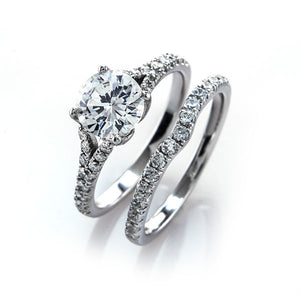
- Remember that settings can help. A halo of melee diamonds around the center stone creates the impression of a significantly larger diamond, and a slender band makes the center diamond appear larger by comparison.
Do Lab Grown Diamonds Measure the Same Size Per Carat?
Great question, and the answer is yes. A lab grown diamond is a real diamond with the same physical and optical properties as a natural diamond, which means it has the same density. Consequently, a 1.00 carat lab grown round faces up at the same 6.5 mm as a 1.00 carat natural round, and every measurement in the chart above applies equally to both. The difference is the price tag, which means that a lab grown diamond allows some shoppers to reach a larger carat size within the same budget. Just remember that the hidden weight problem described above applies to lab grown diamonds too, and frankly, the lab grown market is full of diamonds that were cut for weight instead of beauty. That is why the Brian Gavin premium lab grown diamonds are cut to the same exacting hearts and arrows standards as our natural diamonds, so you get the size and the sparkle.
Frequently Asked Questions About Diamond Carat Size:
How big does a 2 carat diamond look on a finger?
The average 2.00 carat round diamond measures about 8.2 mm in diameter, which is nearly 2 mm wider than a 1.00 carat diamond. In terms of visible surface area, that works out to roughly 62% more coverage on your finger than a one carat, so the difference is dramatic and easy to see from across the room.
Can you tell the difference between a 1.00 carat and a 1.25 carat diamond?
Side by side under close inspection, yes. On its own on somebody’s finger, it’s difficult, because the difference in average diameter is only a fraction of a millimeter. The visual difference between diamonds becomes obvious at intervals of about half a carat, which is why we suggest thinking in half-carat steps when you’re deciding between size tiers.
What is buying shy and how much can it save?
Buying shy means choosing a diamond just below one of the magic carat weights, such as 0.90 instead of 1.00, or 1.90 instead of 2.00. Because price per carat jumps at those thresholds, the savings can be substantial, while the difference in face-up size is practically invisible beyond arm’s length. It is one of the smartest plays available to diamond shoppers.
Does a halo setting make a diamond look bigger?
Absolutely. A halo of small diamonds surrounding the center stone extends the sparkling footprint of the ring, which creates the impression of a much larger center diamond. Pairing a halo with a well-cut center stone is a popular strategy for maximizing perceived size on a budget.
Does carat weight affect how much a diamond sparkles?
Not directly. Sparkle is driven by cut quality, proportions, and optical precision, not by carat weight. A superbly cut 1.00 carat diamond will out-sparkle a poorly cut 2.00 carat diamond every day of the week, and the brighter diamond will even appear larger relative to its measurements. If you want to understand how we verify that performance, read about what the XXX diamond grade is and the AGS Ideal Report by GIA.
Click here to search for over 15,000 GIA XXX Diamonds or Discover the perfection of Brian Gavin’s AGS 000 Super Ideal Hearts and Arrows Diamonds
