








Will a VS-2 clarity diamond be eye clean?
Good morning! I'm preparing to propose and someone referred me to your site. What can you tell me about: CAGS-104066228050 Is it completely eye-clean? Any known issues with it? I'm apprehensive about shopping online for a diamond, as I'm sure you can appreciate. Thanks! - Todah R.
Hello Todah,
Thank you for your question, I can appreciate why you might be feeling apprehensive about shoping for a diamond online, however rest assured that as one of the pioneers of the online diamond industry, we've eliminated a lot of the guesswork and our hands-on selection process ensures that the diamond which you select from Brian Gavin will be vibrant and full of sparkle.
The 0.773 carat, J-color, VS-2 clarity, Brian Gavin Signature Diamond which you reference is completely eye clean from a top down perspective, and the inclusions appear to be "very slight" when the diamond is viewed using 10x magnification, which is typical of the VS-2 clarity rating as used by the American Gem Society Laboratory (AGSL) which is a top tier gemological laboratory.
According to the plotting diagram provided on the Diamond Quality Document issued by the AGSL for this diamond, the primary inclusions consist of crystals and a feather. The diamond crystals are indicated in the center region of the table facet and appear to be quite small, the feather is indicated in the eight o'clock region of the diamond within the upper girdle facets and is also minimal.
If you look at the video of the diamond which we provide, you will be able to see that the diamond crystals appear are barely visible and the size of the diamond is enlarged considerably. You can increase the size of the video screen by clicking on the icon located in the upper right corner of the screen and then move the diamond to the left and right with your mouse to get a better view of the inclusions.
How the facets of a diamond hide inclusions:
When people shop for a diamond, they often express concern that the diamond be "eye clean" and they expect it to be eye clean from every vantage point. However the clarity grade of a diamond is determined by examining the diamond from a top down vantage point, and then determining whether the inclusions are visible to the unaided eye, and to what degree they are visible through a 10x diamond grading loupe.
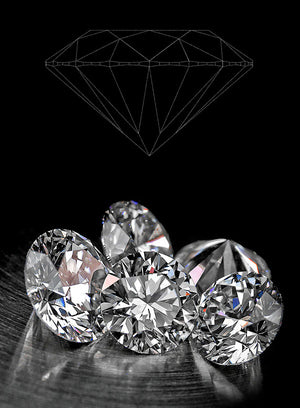
The facet structure of a round brilliant cut diamond is designed so that the facets on the underside of the diamond, which is called the pavilion, are shaped and positioned so that they direct light back up towards the viewer. The facets located on the top half of the diamond, which is called the crown, are designed to break the light apart and create sparkle.
The facets located within the crown section also help to mask the presence of inclusions and make them more difficult to locate, however the facets located on the underside of a diamond act pretty much like a window that looks into the side of a diamond, and as such, inclusions will often be visible from a side profile, even in diamonds with a clarity grade as high as Very Very Slightly Included (VVS).
Determining whether a diamond is "eye clean"
When an experienced diamond grader examines a diamond for clarity, the first thing that they do is evaluate the diamond from a distance of 9 - 12 inches to determine whether it is eye clean. Then the diamond grader will examine the diamond using 10x magnification, which is the industry standard for diamond grading, and determine the type of inclusions present within the diamond, and record the location and extent of the inclusions on the plotting diagram of the lab report.
Each classification of diamond clarity is defined by a set of parameters that outline the basic requirements for inclusion type, location, extent, and quantity. The higher up the clarity scale you go, the fewer inclusions will be present within the diamond, and the more difficult they will be to locate using magnification.
Generally speaking, if the diamond grader is unable to locate any inclusions within the diamond at a distance of 9 - 12 inches, the diamond is likely to receive a clarity grade of at least SI-1 which stands for Slightly Included, Level One.
However not all SI-1 clarity diamonds are eye clean, which is why we often indicate that a diamond is eye clean at the bottom of the video box featured on the diamond details page. We do not indicate that diamonds with a clarity grade of VS-2 and higher are eye clean, because they simply are, it is not a consideration factor in diamonds with a clarity grade higher than SI-1.
