








History of the modern round brilliant cut diamond
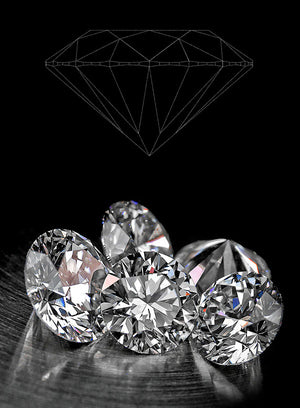
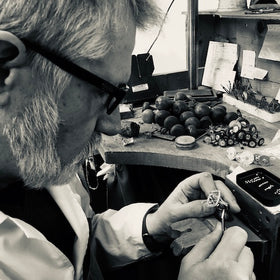
The round brilliant ideal cut diamonds featured within the Brian Gavin Signature and Brian Gavin Blue collections, represent more than six centuries of evolution of diamond design, combined with intensive research into how light travels through diamond, and the diamond cutting skill which has been handed down from father to son within the Gavin family for five generations.
Although there has been a rise in the popularity of round brilliant cut diamonds, which feature the steeper, deeper crown angles of older cuts like the Old European and other transitional round cut diamonds produced between 1870 and 1940, it is unlikely that buyers of these diamonds are buying them for visual performance, as much as they are buying them for the romantic notion that they evoke from a bygone era.
The Effect of Lighting on Diamond Cut Quality:
The Old European cut diamond was designed for an era when our homes and workplaces were illuminated by candlelight, which is where the term “fire” comes from, as used to describe the colored flashes of light created by light reflecting off the facets of a diamond.
As the manner in which we light our living environment has changed, so has the manner in which we cut diamonds for optimum visual performance. The table facet of round brilliant cut diamonds has increased in size, crown and pavilion angle measurements have become shallower, star and lower girdle facet measurements have become longer, and culet sizes have become smaller.
This is due in no small part to the publication of Diamond Design in 1919 by Marcel Tolkowsky, who was a diamond cutter and mathematician, who worked out the best combination of proportions to maximize the volume of light return and brightness from the round brilliant cut diamond design, taking into account the transition from candlelight to electrical lighting which was occurring at the time.
The modern round brilliant cut diamond which features 57 facets, 58 if you count the culet as a facet, entered the scene in the early 1950’s and has been dramatically improved upon over the past few decades do to the emergence of computerized mathematical tracing and proportions analysis programs, which make it possible for diamond cutters to fine tune their production to produce the highest volumes of light return and maximize sparkle.
While I openly admit that the steeper crown angle measurement of vintage cut diamonds like the Old European cut diamond, and modern renditions of round brilliant cut diamonds which are cut modeled after that cutting style which incorporate steeper crown angles, can look amazing in the right lighting environment; how often are you really going to have the opportunity to see your diamond in candlelight?
The effect of the steeper crown angle measurement is a diamond which appears to exhibit more fire / dispersion; however it is at the expense of brilliance, and a reduction in the volume of light return. In addition, vintage cut diamonds tend to exhibit a pattern of light return which is blockier, and more chunk-like than the modern round brilliant ideal cut diamonds produced by Brian Gavin, which are cut to proportions which produce the highest levels of light return, while exhibiting a virtual balance of brilliance and dispersion.
